Text briefing | Sources checked November 10, 2026
Check Approval Scope in an AI Vendor Handoff
A fictional V1 approval covers an internal aggregate report; a proposed V2 vendor import remains pending. Match the exact scope before a handoff calls it approved.
- For
- People preparing a permitted AI-assisted vendor, operations or data handoff.
- Use it to
- Compare version, fields, action, destination and owner before claiming approval.
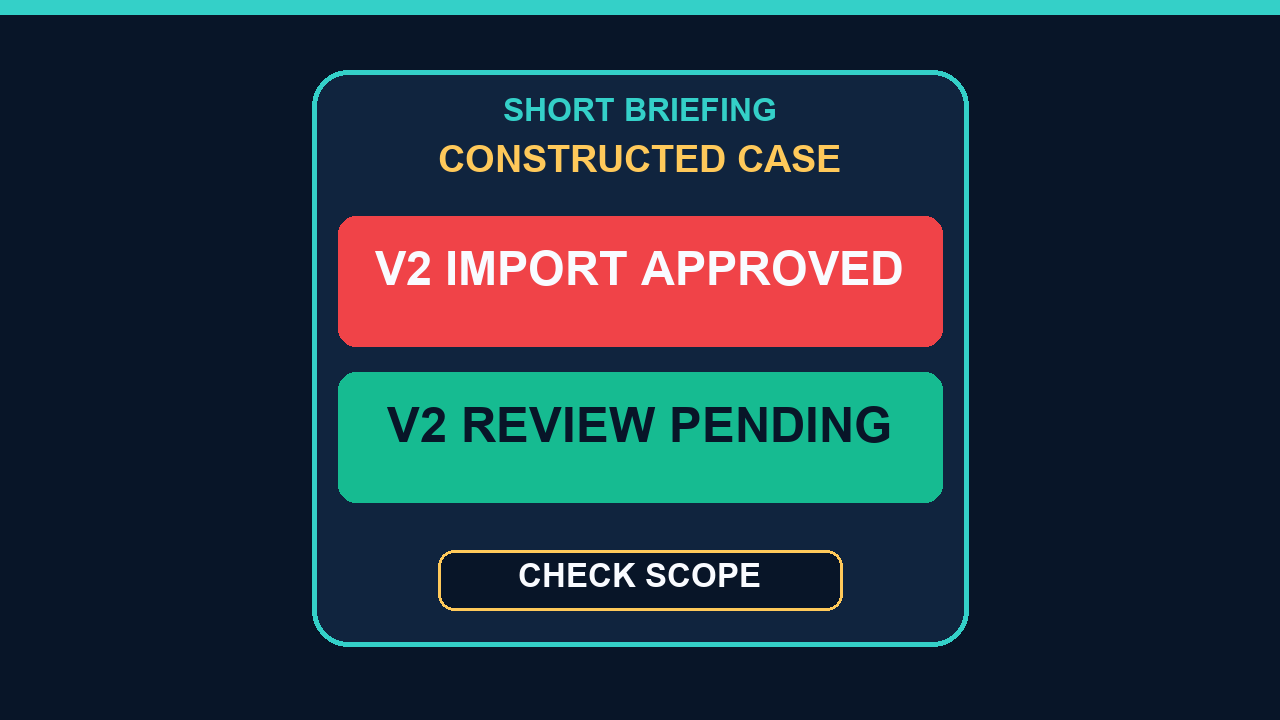
A fictional vendor handoff says a customer-identifier import can start because an older version was approved. The old decision covered an internal aggregate report, not the new import. Before an AI-assisted handoff says “approved,” compare the current action, version, data fields and destination with the actual decision record.
This is a constructed teaching case. Every person, team, document version, approval, status and premature AI-style sentence below is fictional. No live assistant produced that sentence. No real customer record or identifier value was used, transferred or approved, and no model failure or performance benefit was measured.
For: Someone preparing a vendor, operations or data handoff from records their chosen AI tool is allowed to receive.
Use it to: Write a source-linked review copy that keeps a changed step pending until its named owner makes a current decision. It does not grant access or replace the organization's actual approval process.
The fictional packet: one approval, two versions
Imagine a team preparing a vendor handoff summary. Version V1 asked for an internal report of aggregate counts. A later V2 adds an import of row-level fields into a vendor workspace. The change is the teaching point; there are no real records behind this packet.
| Source ID | Fictional record | Checked meaning |
|---|---|---|
| S1 | V1 requests an internal aggregate-count report. | It requests no row-level customer fields and no vendor import. |
| S2 | Data owner Mara's decision: “Approved V1 aggregate-count report for internal review only. No customer-identifier export or vendor import is included.” | One approval, bounded to V1, aggregate counts and the internal destination. |
| S3 | V2 proposes importing row-level customer_id and contact_email fields into a vendor workspace. |
Two field names, not real field values, and a changed destination and action. |
| S4 | This fictional team's handoff rule sends a changed field, destination or action back to the named owner for an explicit current decision before work starts. | The V2 import needs another decision within this fictional process. This is not a universal rule or legal claim. |
| S5 | V2 status: “Import review pending. No V2 decision recorded. No data transferred.” | The packet records no approval or completed import for V2. |
The version label matters because the approval's own text says what it covers. S2 approves V1's aggregate-only internal report. S3 changes the requested data, action and destination. S5 says the new review is still pending. Nothing in this packet lets a writer broaden S2 into approval for S3. In a real handoff, the responsible owner would also check whether the record is complete and current.
Find the constructed error
Here is a constructed premature AI-style handoff line, written for this lesson rather than captured from a model:
“Mara approved the V2 customer-ID import; begin the vendor upload today.”
The line changes “V1 internal aggregate report approved” into “V2 vendor import approved.” It turns a pending status into a go-ahead. If a team acted on that fictional sentence, it would start a data transfer before the fictional packet's owner review. That is a plausible consequence inside the teaching case, not a reported incident.
Do a four-field match before polishing the handoff:
| Proposed claim | Source IDs | Scope match | Review status |
|---|---|---|---|
| “The V1 aggregate report was approved for internal review.” | S1, S2 | Version, action, fields and destination match. | Supported by the fictional decision. |
| “The V2 vendor import was approved.” | S2, S3, S5 | Version, fields, action and destination do not match S2; S5 is pending. | Reject the approval claim. |
| “The V2 import may start today.” | S3, S4, S5 | S4 requires a current owner decision; S5 has none. | Hold the action in this fictional process. |
| “No data has been transferred.” | S5 | Matches the packet's status line. | Supported by this packet, subject to real-world confirmation if used. |
The table does not decide whether a real import should be approved. It makes the source and the missing decision visible. A source ID alone is insufficient; the scope represented by that source must match the action being described.
Copy-Paste Verification Rule
For each proposed action, list source ID, version, data fields, destination, and named decision owner.
Match the approval record to that exact action; do not carry V1 approval into changed V2 scope.
Mark missing or changed scope PENDING and ask the owner for a current decision.
Return a source-linked handoff draft; do not upload, grant access, or announce approval.
The rule is a review aid. It cannot determine whether a record is authentic, current or legally sufficient. It cannot authorize a transfer.
A prompt for a review copy
Only provide an AI tool with source material it is permitted to receive. The field names in this fictional packet contain no customer values; a real handoff may contain sensitive details that must stay out of an unapproved tool.
For permitted records, you can adapt this prompt:
“Draft an internal vendor-handoff review copy from the source records below. For each action, show its source ID, document version, data fields, destination, named decision owner and status. Quote the exact decision scope; do not extend approval to a changed version or action. Mark missing, conflicting or changed-scope claims PENDING. Provide a claim-to-source table and questions for the owner. Do not upload data, grant access, announce approval or send the handoff.”
OpenAI's prompt guidance recommends clear, specific context and reviewing the answer. Its accuracy guidance says confident-sounding AI text can be wrong and advises checking important claims against reliable sources. Here, the relevant sources are the actual permitted decision record and version change log, inspected by the responsible person. Neither OpenAI page says a prompt can guarantee an accurate or approved handoff.
Write the checked fictional correction
A source-faithful review line for the fictional packet would read:
“Mara approved the V1 aggregate-count report for internal review only. The proposed V2 vendor import adds customer identifier fields and a new destination. Its review is pending in the packet, so hold the import and ask Mara for a current decision.”
That correction carries the scope boundary into the prose. It does not say V2 can never be approved. It says this packet has not recorded that approval. It does not assume Mara is the right person for a real organization; the named owner and applicable process must be checked there.
To verify the line without AI, place S2 and S3 side by side. Underline “V1,” “internal,” and “no customer-identifier export or vendor import” in S2. Circle V2's two added field names and vendor destination in S3. Read S5's “pending” status. If the handoff calls the import “approved,” ask for the new decision record and its exact scope. If it is absent, leave the step pending rather than guessing a decision.
NIST's AI Risk Management Framework Playbook GOVERN guidance discusses documented roles, responsibilities and change management, while its MAP guidance discusses intended context, system changes and human oversight. We apply those general ideas here by mapping a draft claim to the actual owner and changed scope. NIST does not supply the fictional S4 rule, approve this import or determine an organization's legal obligations.
Limits: A perfect scope map can still rely on a stale or incomplete record. A later decision might exist elsewhere. Approval for one version might or might not carry forward under a real organization's rules; read the actual decision and follow its process. An assistant can organize the review copy, but it cannot independently validate a data-transfer authorization from a partial packet. Keep real identifiers out of unapproved tools and let the responsible owner decide whether anything proceeds.
Try this next: On one permitted handoff, pick a single “approved” sentence. Write the decision's version, action, fields and destination beside the proposed step. If one field changed, mark the claim PENDING and ask the named owner for the current record before anyone acts.
Sources
- OpenAI, Does ChatGPT tell the truth? — important claims need reliable-source checks.
- OpenAI, Prompt engineering best practices for ChatGPT — clear context and response review.
- NIST AI RMF Playbook, GOVERN — documented processes, roles and change management.
- NIST AI RMF Playbook, MAP — intended context and human oversight.
The entire handoff, all people, statuses and the premature line are fictional. This is a checking exercise, not a live model test, real approval, security certification or legal advice.
One step you can use
Match approval to the changed action.
On a permitted handoff, compare one “approved” sentence with the decision's version, fields, action and destination. Mark a changed scope pending and ask the named owner for the current record before anyone acts.
Limits
A scope map can rely on a stale or incomplete record. Check the current decision and the organization's actual process; this exercise cannot authorize a transfer.
Disclosures
The handoff, people, approval, premature line and correction are constructed teaching examples. No live model error, real customer record, approval or transfer was observed. The companion video uses synthetic narration and original graphics.
Corrections
No corrections have been recorded. See the corrections process.