Text briefing | Sources checked November 9, 2026
Check Monthly and One-Time Costs in AI Budget Drafts
A fictional budget draft calls a one-time fee monthly. Check each pricing row's time basis before the brief moves forward.
- For
- People preparing a permitted AI-assisted internal budget or pricing review draft.
- Use it to
- Separate recurring and one-time charges, show source rows, and leave missing terms open for owner review.
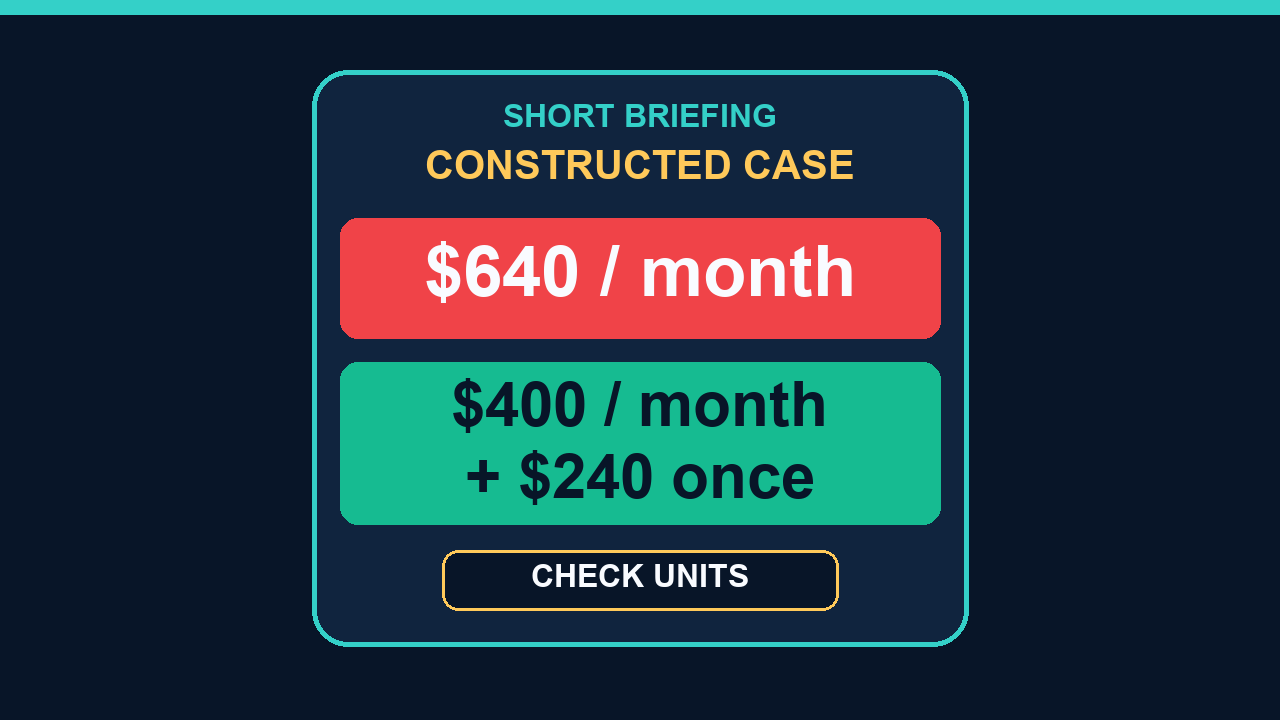
A constructed executive budget draft counts a one-time setup fee as if it repeats every month. That changes the reported recurring cost from $400 per month to $640 per month. Before asking AI to summarize a pricing table, label each row's unit and time basis, then check the arithmetic yourself.
This is a constructed teaching case. The company, seat counts, prices, source table, premature draft and correction below are fictional. No live assistant produced the premature line, no real budget was reviewed or approved, and no cost saving or model performance was measured. The figures teach a checking method; they are not a quote, offer or financial recommendation.
For: A person using an approved AI tool to prepare an internal budget or pricing summary from material that the tool is permitted to receive.
Use it to: Keep recurring and one-time amounts in separate subtotals, show the source for each row, and leave missing fees or approvals open for a responsible reviewer.
Start with a fictional pricing table
Imagine a team has an internal draft table for a proposed software service. The numbers are deliberately small enough to verify without AI. The source IDs are part of this teaching packet, not references to a real vendor.
| Source ID | Fictional source row | Time basis | Checked extension |
|---|---|---|---|
| S1 | 12 standard seats at $30 per seat | Per month | 12 × $30 = $360 per month |
| S2 | 5 add-on seats at $8 per seat | Per month | 5 × $8 = $40 per month |
| S3 | One setup fee of $240 | Once | 1 × $240 = $240 once |
S1 and S2 have the same time basis, so their recurring subtotal is $360 + $40 = $400 per month. S3 has a different basis. It is $240 once, not another $240 per month. Adding the amounts without their units gives $640, but calling that number a monthly total changes what the source says. The packet does not specify taxes, other fees, a start date, a contract term or approval to buy. Leave those fields unknown.
This is not a warning against addition. It is a warning against adding unlike units and then giving the result one of their labels. You can use the $640 arithmetic sum only if you explicitly define a context, such as a first month that includes the one-time fee, and verify that the source supports that context. This packet does not approve a purchase or establish what a real first invoice will contain.
Find the constructed error
Here is a constructed premature AI-style draft, not output from a live model:
“The recurring cost is $640 per month, including the setup fee.”
The source supports $400 per month in seat charges and a separate $240 setup fee once. The premature sentence takes a true arithmetic sum and assigns it the wrong time basis. An executive could repeat that sentence in a brief and misstate the proposed ongoing cost. We have not observed that event; it is the workplace consequence this fictional example illustrates.
Put every proposed figure in a check table before polishing the prose:
| Draft claim | Source IDs | Unit and time check | Status for review |
|---|---|---|---|
| Standard seats: $360/month | S1 | 12 × $30/seat/month | Supported by fictional row |
| Add-on seats: $40/month | S2 | 5 × $8/seat/month | Supported by fictional row |
| Recurring subtotal: $400/month | S1 + S2 | $360/month + $40/month | Supported by fictional rows |
| Setup: $240 once | S3 | 1 × $240/one-time fee | Supported by fictional row |
| “$640/month recurring” | S1 + S2 + S3 | Mixes monthly and one-time units | Reject the monthly label |
| Taxes, extra fees, term or approval | None in packet | No source supplied | Unknown; ask the owner |
The last two rows matter as much as the multiplication. A model can write a fluent total, but fluency does not establish that each input belongs in the same subtotal. OpenAI's accuracy guidance says an AI response may sound confident while being wrong and recommends checking important information against reliable sources. For this task, the immediate source is the permitted pricing table and the person responsible for it.
Copy-Paste Verification Rule
Label every row: quantity, unit price, time basis, source ID.
Multiply each row; add only amounts with matching time bases.
Show monthly and one-time subtotals; mark missing terms UNKNOWN.
Return a source-linked review copy; do not approve or send it.
Keep those four lines with the draft. The rule creates a review path, not a guarantee that AI will calculate correctly or that the source table is complete.
Ask for a review copy, then check it
First confirm that the chosen tool is allowed to receive your real pricing data. The fictional rows above are safe practice material; a real vendor quote or company budget may be restricted. If the tool and input are permitted, a narrow prompt could be:
“Using only the source rows below, prepare an internal budget-review summary. Keep the source ID, quantity, unit price and time basis visible for every row. Multiply each row, add monthly charges separately from one-time charges, and show the arithmetic. Mark taxes, extra fees, term and purchase approval UNKNOWN when the source does not state them. Return a claim-to-source check table. Do not approve, send or purchase anything.”
OpenAI's prompt guidance recommends clear, specific context and reviewing the response. The prompt specifies the units and output format so a reviewer can find a mixed-basis total. It does not replace the manual calculation.
A checked correction for this fictional packet reads: “The proposed seat charges total $400 per month: $360 for standard seats and $40 for add-on seats. A $240 setup fee is listed once, separately. Taxes, other fees, the term and approval remain open for review.” Each number has a visible source row and time basis. It is still an internal review copy, not an approved purchase or real quote.
Before using a draft, reproduce the two multiplications and one same-unit addition without the model. Point to S1 for 12 × 30 = 360, S2 for 5 × 8 = 40, and S1 plus S2 for 360 + 40 = 400. Point to S3 for the separate 240 once. If a sentence says “per month,” ask which rows actually have that basis. If an amount or term has no current source, leave it open and ask the responsible person.
NIST's AI RMF Playbook MAP 3.5 discusses defining and documenting human oversight processes. The practical boundary here is modest: an assistant can help organize a review copy, while a human checks the source, resolves missing terms and decides whether anything is ready for use. This example is not accounting, procurement or contract advice.
Limits: A correctly separated table can still be incomplete, outdated or misunderstood. Discounts, minimums, taxes, proration and contract terms could change a real invoice, and none are specified in this fictional packet. Do not invent them. If the proposed spending is consequential, the right owner should verify the original terms and approve the decision through the organization's process.
Try this next: Take one permitted pricing or budget table. Write “per month,” “per year” or “once” next to each row before asking AI for a summary. Check one recurring subtotal by hand, keep one-time charges separate, and send the resulting claim-to-source review copy to the responsible person.
Sources
- OpenAI, Does ChatGPT tell the truth? — recommends checking important AI-generated claims against reliable sources.
- OpenAI, Prompt engineering best practices for ChatGPT — clear context and review of output.
- NIST AI RMF Playbook, MAP 3.5 — documented human oversight processes.
All company, pricing and draft content above is fictional. The arithmetic is an independently checked illustration, not a measured AI result or financial recommendation.
One step you can use
Label the time basis before totaling.
On a permitted pricing table, mark each row per month, per year or once. Check one subtotal by hand and give the source-linked draft to its owner for review.
Limits
The fictional table omits taxes, discounts, contract terms and approval. A separated subtotal can still be incomplete or stale; verify original terms with the responsible owner.
Disclosures
The company, prices, draft error and correction are constructed teaching examples. No live model error, real purchase or financial outcome was observed. The companion video uses synthetic narration and original graphics.
Corrections
No corrections have been recorded. See the corrections process.